Overview
The thyroid gland is an endocrine gland located in your neck. The word endocrine means it controls the hormones of your body. This vital gland; through hormonal control, indirectly controls all the organs of your body. It plays a pivotal status in controlling your basal metabolism, sleep, heart rate, growth, bodily functions and overall development. Any lump or lesion developing within the thyroid gland is called a thyroid nodule. Thyroid nodules may be solid or fluid-filled i.e cystic. These nodules are very common in the general population and as per data can be present in roughly 1 of 3 individuals.
As stated above, thyroid nodules are very common and most are asymptomatic. However, every nodule needs to be evaluated. Your doctor would first examine you and ask for investigations. Most importantly, it is important to know whether the nodule is arising from thyroid or from a surrounding structure (i.e. extra-thyroid). An ultrasound (USG) is the best investigation to evaluate the thyroid nodule. This is required to know the size, location and nature of the lump or mass/nodule. Most thyroid nodules are benign i.e non-cancerous. You need not worry. Almost 95% are benign. Only a small percentage (around 5%) of thyroid nodules may be worrisome i.e are cancerous.
Symptoms & Diagnosis of Thyroid Nodule
Most often, you won’t even know you have a thyroid nodule as they have no symptoms. These are most likely incidentally detected or discovered during a heath check up. Rarely, your doctor may find it during a neck examination. In other cases, it may be picked up on a CT scan or ultrasound done for other reasons.
However, that said, large thyroid nodules may have symptoms. These symptoms include:
- Feeling of a lump, difficulty in eating or swallowing.
- Difficulty in breathing or occasional pain and heaviness.
- A cancerous nodule may present with pain, nausea, weight loss and anorexia/loss of appetite.
Diagnosis of Thyroid Nodule
- Work up starts with a physical examination.
- Your doctor will most likely ask for a few blood tests including a thyroid profile (T3, T4, TSH levels).
- An ultrasound of the neck Is the first imaging advised. USG is cheap, easy and poses no hazards.
- This would most likely be followed by a biopsy or an FNAC. A biopsy/FNAC is a needle test performed under local anaesthesia, wherein a sample from the nodule is removed.
- The FNAC usually differentiates benign from malignant nodules.
Benign Thyroid Nodule & Treatment
If the nodule turns out to be cancerous or malignant
In this case, the most likely option is surgery or chemotherapy. This may be combined with radioactive Iodine therapy. You would require a mullti-disciplinary team of doctors for taking the right decision for you, this would include a medical oncologist, a surgical oncologist, an endocrinologist, an interventional radiologist and a pathologist. They would advise the next steps of investigations and treatment plan.
If the nodule turns out to be benign
It is a positive news if the nodule turns out to be benign. If the nodule is small (<2 cm), nothing needs to be done. Only follow-up is required. A wait and watch policy may be offered. Every 6 months or yearly, an ultrasound may be suggested to make sure that the nodule is not increasing in size.
Some thyroid nodules are however pretty big and may cause symptoms. Even though the nodule is benign, since it is symptomatic, treatment may be required. This varies from case to case. Symptoms include:
1. The nodules may be felt – hard or painful.
2. May be seen, often as a swelling at the base of your neck; causing cosmetic disfigurement.
3. They may press on your windpipe or esophagus, causing shortness of breath or difficulty during swallowing (i.e dysphagia or dyspnea).
4. In some cases, these thyroid nodules shall produce additional thyroxine, a hormone secreted by your thyroid gland. These are called autonomous or functioning nodules. The hormone produced by the nodule can cause something called as hyperthyroidism. Symptoms of hyperthyroidism include:
- Unexplained weight loss
- Increased sweating
- Tremors
- Nervousness
- Rapid or irregular heartbeat
Overall, such symptomatic benign thyroid nodules require treatment
Treatment options for a benign symptomatic thyroid nodule
Conventionally, open surgery has been offered for benign thyroid nodules. This would involve removing the nodule and a part of the thyroid gland (a procedure called hemithyroidectomy) or the entire gland (total thyroidectomy). Surgery has its own issues: long term hormone supplementation and surgical complications. Hence, for such symptomatic benign thyroid nodules a treatment now offered is: percutaneous thermal ablation of the nodule.
Percutaneous Thermal Ablation of the Thyroid Nodule
Overview
“Percutaneous” means through the skin. The word ablation means destruction of tissue. “Thermal” means heat.
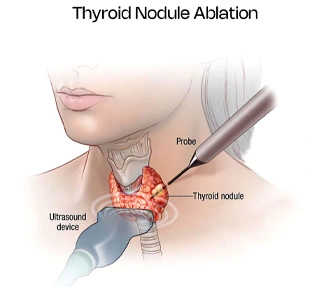
Therefore this procedure involved destroying the nodule using a special device through your skin with the help of heat.
Heat is given either in the form of radiofrequency energy (RFA) or microwaves (MWA). We have used RFA and MWA safely in other organs like the liver and lung for almost 20 years for destroying liver and lung tumours.
Thyroid RFA has been performed at specialist centres abroad for many year.
Benefits of percutaneous radiofrequency thyroid nodule ablation compared to open surgery
- It is minimally invasive compared to surgery, called minimally invasive treatment (MIT)
- No need for general anesthesia
- Shorter hospital stay
- Faster recovery
- No scar on incision. No cut
- Most importantly, the thermal ablation does not involve removal of part of thyroid gland or parathyroid gland. Therefore, post procedure hormonal changes do not happen
Why Choose Dr Aser for Percutaneous Thyroid ablation Procedures?
- Subspecialty training in Musculoskeletal Radiology and Interventional Radiology in the UK and Canada
- Access to advanced imaging and Angio Suite facilities in a tertiary centre
- Collaboration with orthopaedics, sports medicine, rheumatology, physiotherapy and pain specialists
- Focus on clear explanation, realistic expectations and only recommending procedures where there is a reasonable chance of benefit
FAQ
1. What are the risks?
No procedure can be risk free. But since thermal ablation is a minimally invasive treatment option (MIT), risks are much lesser than open surgery. Serious complications are extremely rare. The main risk is hoarseness of voice on the post procedure follow up. This happens due to nerve injury. Even if this ensues, it is self limiting and generally recovers on its own over 1-3 months.
2. What is Step-by-Step Thyroid Nodule Ablation Procedure?
- Your scan shall first be evaluated by the interventional radiologist. This shall be done prior to the procedure.
- The procedure shall be explained to you in detail.
- Based on USG, it shall be confirmed that it is likely benign. This is based on the TIRADS system of classification.
- Your doctor would reconfirm that the nodule is benign: generally 2 FNACs and/or biopsies shall be done to re-confirm that it is a benign nodule only and does not harbour a malignancy.
- After this is confirmed, your procedure shall be scheduled.
- The procedure is done on a Day Care/OPD basis.
- Wear loose clothes. An accompanying relative is mandatory.
- You will be asked to stay nil by mouth for 6 hours for solid foods and 2 hours for clear liquids. Written informed consent will be taken.
- You will be lying down on your back with head extended. Your doctor shall stand at the head end.
- Local anesthesia will be infiltrated upto the thyroid gland capsule in the neck to numb the area.
- A special needle/electrode/probe will be inserted into the nodule using USG guidance.
- Using heat (either in the form of microwaves or radiofrequency), the nodule shall be burnt.
- Depending on the size, shape and other factors, one nodule ablation takes 45 min to an hour.
3. How should I prepare?
-
Book your appointment and visit the clinic for your pre-procedure evaluation.
-
Bring any previous imaging, including MRI, CT scans, or ultrasound results.
-
Stop blood-thinning medications (such as Aspirin, Plavix, or Warfarin) only if your doctor instructs you to do so.
-
Have a light breakfast on the day of the procedure unless told otherwise.
-
Bring someone with you to accompany you and assist after the procedure if needed.